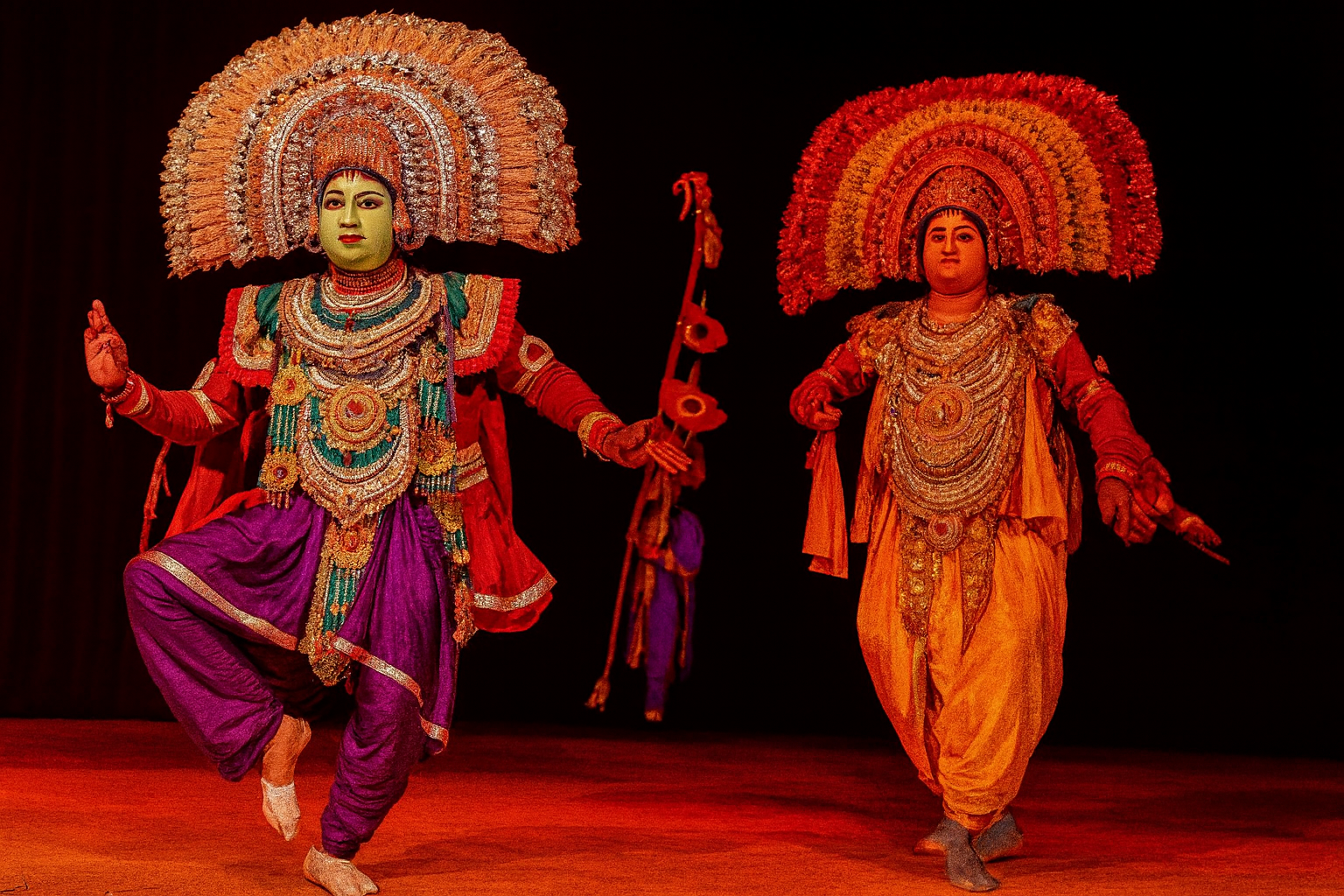
Chhau Dance: Cultural Trait of Purulia District, West Bengal, India
DOI:
https://doi.org/10.62012/jacs.v2i2.19Abstract
In both political and legal spheres, culture is pervasive and fundamental to the human condition. Culture is the entirety of conduct and belief; it encompasses both normative and taught behaviour. The Chhau dance of Purulia, West Bengal, India, is included in the study. It's the dance of the earthen mask. The several kinds of drums are performed as background music in Chhau dance. It’s a self-defence martial art. The ancient Purulian people inherited Chhau dance. It's an athletic and acrobatic Indian dance that's done at Hindu festival. The various attributes of dance—the choreography, costume, and lyric patterns—have been discussed. The Chhau dance of Purulia is included on the list of intangible cultural heritage of UNESCO. The dance is distinct due to its rigorous training and accuracy, and it is a dance of heroic gesture. Purulia's Chhau dance is more specifically regional than community-specific. Instrumental music, dance, and martial arts are all combined in Chhau dance. It connects the various communities and their technical expertise and skills. The Chhau dance with conciliatory (with mask) actorish gestures is the cultural trait of Purulia, West Bengal.
Downloads
References
References
R. Das, "Mime, movement and masks. The narrative technics of the traditional Indian dance," in Bewegungsfreiheit: Tanz als kulturelle monifestation (1900-1950), Austria, Karl Franzens Universiat Graz, 2017, p. 179.
P. P. Mahato and K. C. Mahato, Collective wisdom and excellence related to world views on forest, biodiversity and nature-man sprite complex of the indigenous people of Eastern India, New Delhi: Concept Publication Company, 2007.
S. Cardinala, "Intangible Cultural heritage revitalization for development and tourism: A case of Purulia Chhau dance," Material cultural review, vol. 82, no. 83, pp. 43-58, 2015.
"Browse the Lists of Intangible Cultural Heritage and the Register of good safeguarding practices," 2 MAY 2021. [Online]. Available: https://ich.unesco.org/en/lists#2010.
D. Chatterjee, "Mask and Costume of Purulia Chhau," Asian Theatre Journal, vol. 36, no. 1, pp. 221-238, 2019.
M. David, A. Bonds, M. Bethe, K. Pauka and L. Mceker, Costume and make-up in traditional Asian theatre, Handbook of Asian Theatre, London: Routledge, 2016.
R. Chatterjii, "Purulia Chho discarsive space and the constituion of culture," in Folklore public sphere and civil society, New Delhi, Indira Gandhi National Centre for the Arts, 2004, pp. 37-54.
W. Witharana, Usage of arenas in Kolan and Indian Chhau theatre, Peradeniya. Sri Lanka: University of Peradeniya, 2014.
Govt of India, "Indian Culture, Discover, Learn, Immerse, Connect," 2 May 2021. [Online]. Available: https://indianculture.gov.in/intangible-cultural-heritage/performing-arts/chhau-dance.
W. Drid, Anthropology and the dance. ten lectures, Chicago: University of Illinois press, 2004, pp. 70-89.
"Bengal’s Chau mask acquires GI fame," 8 MAY 2021. [Online]. Available: https://www.thehindu.com/news/cities/kolkata/bengals-chau-mask-acquires-gi-fame/article24028259.ece.
A. H. Guest, Your move: A new approach to the study of movement and dance, vol. 1, London: Rutledge, 1983.
A. Atto, Politics of cultural amnesia: a case study of Machhani folk dance form of Purulia Indranil Acharya, vol. IX, Bhubaneshwar,: Folklore Foundation of India, 2016, pp. 84-88.
I. Acharya, "Aestheticizing without agenda: A counter reading of western approach of Chhau dance," Rupkatha journal of Interdiciplinary studies in humanities, vol. 2, no. 2, pp. 89-97, 2013.
S. B. Shapiro, Dance in a world change, reflection on globalization and cultural difference, Champaign, USA: Human kinetics, 2008.
R. Guha, The prose of counter insurgency, culture/power/history: A reader in contemporary social theory, vol. 12, Pinceton: Pinceton University, 1994, pp. 336-371.
B. Dasgupta, European trade and colonial conquest, vol. 1, London: Anthem press, 2005, p. 398.
J. Blacking and J. W. Keallinohomoko, "The performing arts:music and dance," vol. 10, Bristol, Walter de Gruyter, 1979, pp. 3-10.
D. Reck, "The music of matha 'Chhau'," Asian Music, vol. 3, no. 2, pp. 8-14, 1972.
P. Descola, Beyond nature and Culture, London: Rputledge, 2013.
T. J. Buckland, Dancing from past to present nation, Cultural identities, London, England: University of Wisconsin press, 2007.
P. Karkanas, "Late Neolithic household activities in merginal areas: the micromorphological evidence from the Kauveleiki caves, Peloponnese, Greece," Journal of Archaeological science, vol. 33, no. 11, pp. 1628-1641, 2006.
M. E. Goldberger, A conservation study of an Anasazi earthen mural art of Aztec ruins National monument, Pennsylnania: University of Pennsylvanis, 1992, pp. 124-135.
I. D. Rowland and T. N. Howe, Vitruvius ten books on architecture, Cambridge: Cambridge University Press, 2001.
L. L. Mascia, "A Vitruvius inspired criterion for the construction of polygons," Nexus Network Journal, vol. 18, no. 2, pp. 533-545, 2016.
J. Yap, The art of lion dance, vol. 1, Kuala Lumpur, Malaysia: Joey yap research group, 2017.
"West Bengal public library network," 2021. [Online]. Available: http://hdl.handle.net/10689/18270.
"Department of Planning & Statistics, Govt of West Bengal," 2021. [Online]. Available: http://www.wbpspm.gov.in/publications/District%20Human%20Development%20Report.
E. Moor, The Hindu pantheon, New Delhi: Asian Educational Service, 1810.
A. Guha, "An early freedom struggle that is still not free of the Chuar label," July 2018. [Online]. Available: https://www.researchgate.net/profile/Abhijit-Guha-5/publication/326410424_An_early_freedom_struggle_that_still_not_free_of_the_chuar_label/links/5b4ba3eba6fdccadaecefaf9/An-early-freedom-struggle-that-still-not-free-of-the-chuar-label.pdf.