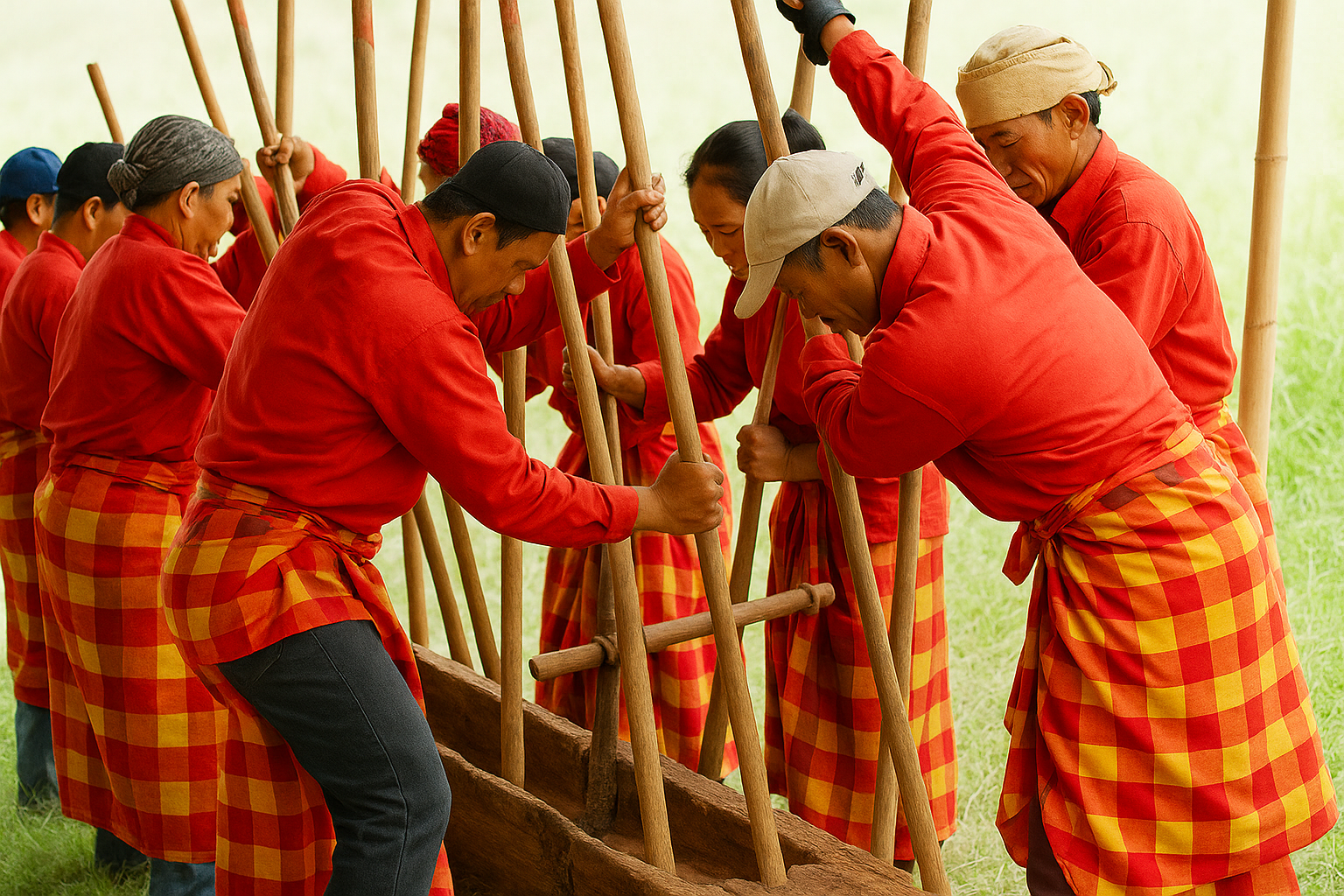
Mappadendang and the Politics of Religious Orthodoxy: Cultural Adaptation in Contemporary Bugis Society
DOI:
https://doi.org/10.62012/jacs.v2i2.21Keywords:
Mappadendang, Orthodox Islam, Local Culture, Cultural Politics, Adaptation of Tradition, Bugis SocietyAbstract
This study examines the transformation of Mappadendang, a traditional Bugis harvest ritual, amidst the rise of Islamic orthodoxy in contemporary Indonesia. Once a unifying cultural celebration, Mappadendang has experienced a decline in Muslim participation due to increasing scripturalist interpretations that view the ritual as incompatible with religious doctrine. Employing an ethnographic case-study approach in a South Sulawesi village, this research explores the community’s adaptive strategies, including ritual negotiation, symbolic reinterpretation, and religious reframing. The findings highlight how local actors maintain cultural resilience by transforming tradition into forms more acceptable to dominant religious norms. Through the frameworks of cultural politics and Islamic modernisation, the study underscores that cultural change in Muslim societies involves negotiation, not merely rejection, of heritage. This work contributes to broader discourses on religious orthodoxy, local identity, and the politics of cultural adaptation in plural societies.
Downloads
References
I. G. P. B. S. Arjawa and Z. Zulkifli, “The Social Integration of Hindu and Muslim Communities: The Practice of ‘Menyama-Braya’ in Contemporary Bali,” Studia Islamika, vol. 28, no. 1, pp. 149–178, Apr. 2021, doi: 10.36712/sdi.v28i1.10914.
D. Kirana and E. A. Garadian, “Religious Trend in Contemporary Indonesia: Conservatism Domination on Social Media,” Studia Islamika, vol. 27, no. 3, pp. 615–622, Dec. 2020, doi: 10.36712/sdi.v27i3.18823.
B. Badrun, I. Muttaqin, R. Morganna, S. Sujadi, and I. Warsah, “Pancasila, Islam, and Harmonising Socio-Cultural Conflict in Indonesia,” Al-Jami’ah: Journal of Islamic Studies, vol. 61, no. 1, pp. 137–156, Nov. 2023, doi: 10.14421/ajis.2023.611.137-156.
M. Adil and M. Huda, “Understanding Responses to Worship Regulations in the Pandemic Era: Text Data Mining Analysis in the Indonesian Context,” Religions, vol. 14, no. 4, p. 549, Apr. 2023, doi: 10.3390/rel14040549.
C. Mahfud, A. Kasdi, M. A. Mu’Ammar, M. Muyasaroh, F. Wajdi, and R. Astari, “Islamic cultural and Arabic linguistic influence on the languages of Nusantara; From lexical borrowing to localized Islamic lifestyles,” Wacana, vol. 22, no. 1, p. 224, May 2021, doi: 10.17510/wacana.v22i1.914.
M. Misbahuddin, T. Samsudin, A. I. Cahyani, I. Z. Fuad, and A. Ys, “Normativism of Islamic Law in the Akkattere Hajj Ritual of South Sulawesi’s Ammatoa Community,” Samarah: Jurnal Hukum Keluarga dan Hukum Islam, vol. 7, no. 1, p. 629, Mar. 2023, doi: 10.22373/sjhk.v7i1.15987.
I. Nafi’A, R. Rokhmadi, M. A. Hakim, S. Safii, and S. Gumiandari, “Mitigating radicalism amongst Islamic college students in Indonesia through religious nationalism,” HTS Teologiese Studies / Theological Studies, vol. 78, no. 4, Jul. 2022, doi: 10.4102/hts.v78i4.7547.
H. Fernando, I. Abdullah, and M. Yusuf, “Religion and the pandemic trap: Muslim worship post-COVID-19 in Indonesia,” Culture and Religion, vol. 22, no. 4, pp. 398–415, Oct. 2021, doi: 10.1080/14755610.2023.2288344.
A. Sebastian, “Matrilineal practices among muslims: An ethnographic study of the Minangkabau of West Sumatra,” Ethnography, p. 146613812211471, Dec. 2022, doi: 10.1177/14661381221147137.
M. Latif and E. Hafid, “multicultural attitudes in an Islamic boarding school of South Sulawesi – Indonesia,” Cogent Education, vol. 8, no. 1, Jan. 2021, doi: 10.1080/2331186x.2021.1968736.
M. Mukrimin and G. Acciaioli, “Frontier formation in an Indonesian resource site,” Journal of Political Ecology, vol. 30, no. 1, May 2023, doi: 10.2458/jpe.5673.
M. A. Anshori, L. Muhtifah, and Z. H. Prasojo, “Contribution of Sufism to the Development of Moderate Islam in Nusantara,” International Journal of Islamic Thought, vol. 19, no. 1, pp. 40–48, Jun. 2021, doi: 10.24035/ijit.19.2021.194.
I. Mujahid, “Islamic orthodoxy-based character education: creating moderate Muslim in a modern pesantren in Indonesia,” Indonesian Journal of Islam and Muslim Societies, vol. 11, no. 2, pp. 185–212, Dec. 2021, doi: 10.18326/ijims.v11i2.185-212.
A. Setiawan, “Polemic and Reasons for Reusing Wayang and Gamelan as A Medium for Contemporary Preaching Islam Religion in Central Java, Indonesia,” Harmonia: Journal of Arts Research and Education, vol. 22, no. 2, pp. 254–267, Dec. 2022, doi: 10.15294/harmonia.v22i2.37525.
A. Maimun, M. Mujab, and A. Indiyanto, “EDUCATING ISLAMIC VALUES THROUGH WIWITAN TRADITION,” JOURNAL OF INDONESIAN ISLAM, vol. 14, no. 2, p. 359, Dec. 2020, doi: 10.15642/jiis.2020.14.2.359-386.
S. Sumarni and A. K. Kalupae, “Preserving the values of cultural negotiation through social learning: ‘Two Religion Community Life’ case study in Phattalung, Southeast Thailand,” HTS Teologiese Studies / Theological Studies, vol. 76, no. 1, Jul. 2020, doi: 10.4102/hts.v76i1.5947.
N. Hasan, A. Hannan, M. I. Ghafiri Enhas, and M. Taufiq, “Tradition, Social Values, and Fiqh of Civilization: Examining the Nyadran Ritual in Nganjuk, East Java, Indonesia,” Samarah: Jurnal Hukum Keluarga dan Hukum Islam, vol. 7, no. 3, p. 1778, Nov. 2023, doi: 10.22373/sjhk.v7i3.20578.
M. A. Safa’At, “The Roles of the Indonesian Constitutional Court in Determining State-Religion Relations,” Constitutional Review, vol. 8, no. 1, p. 113, May 2022, doi: 10.31078/consrev815.
E. F. Nisa and F. F. Saenong, “Relegitimizing Religious Authority: Indonesian Gender-Just ʿUlamāʾ Amid COVID-19,” Religions, vol. 13, no. 6, p. 485, May 2022, doi: 10.3390/rel13060485.
S. E. Zaluchu, “Digital Religion, Modern Society and the Construction of Digital Theology,” Transformation: An International Journal of Holistic Mission Studies, vol. 41, no. 4, pp. 285–295, Jan. 2024, doi: 10.1177/02653788231223929.
U. Indonesia, M. Zamzami, M. Muktafi, S. R. Nisok, Z. Mukaffa, and A. A’La, “Mainstreaming Religious Moderation in the Digital Space: An Examination of Islami.co Web Portal in the Perspective of Jürgen Habermas’ Communicative Rationality,” Jurnal Komunikasi: Malaysian Journal of Communication, vol. 39, no. 1, pp. 73–91, Mar. 2023, doi: 10.17576/jkmjc-2023-3901-05.
W. Wasino, E. S. Hartatik, and F. A. Shintasiiwi, “Wong Cilik in Javanese History and Culture, Indonesia,” KEMANUSIAAN The Asian Journal of Humanities, vol. 28, no. 2, pp. 31–51, Oct. 2021, doi: 10.21315/kajh2021.28.2.2.
P. S. Winanti and H. Hanif, “When global norms meet local politics: Localising transparency in extractive industries governance,” Environmental Policy and Governance, vol. 30, no. 5, pp. 263–275, Aug. 2020, doi: 10.1002/eet.1907.
A. Wahid, “Transforming rituals: Creating cultural harmony among the Dou Mbawa of eastern Indonesia,” HTS Teologiese Studies / Theological Studies, vol. 78, no. 1, Jul. 2022, doi: 10.4102/hts.v78i1.7748.