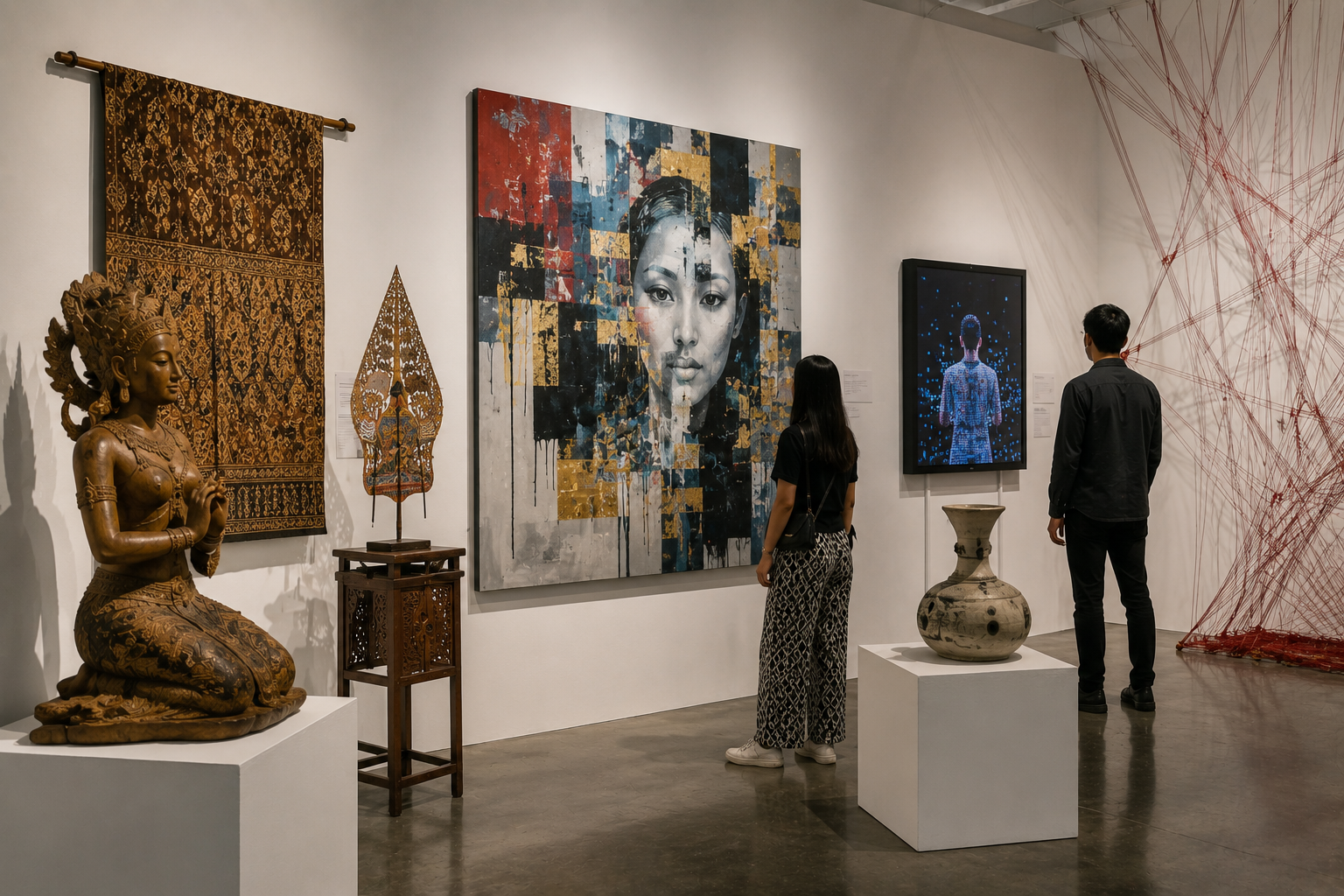
A Dialogue between Traditional and Contemporary Fine Arts
DOI:
https://doi.org/10.62012/p3xva967Keywords:
Traditional Art, Contemporary Art, Cultural Dialogue, Hybridity, Artistic IdentityAbstract
Traditional art and contemporary art are often positioned dichotomically: one is perceived as representing the values of the past, while the other is understood as an expression of novelty and experimentation. This article aims to examine the dialogue that occurs between traditional and contemporary art, both in terms of concept, medium, and cultural meaning. Through a qualitative-descriptive approach and literature study, the discussion is focused on how contemporary artists reinterpret elements of tradition and how traditional art adapts in the contemporary context. The results of the study show that the relationship between the two is dialogical and dynamic, not mutually negotiating, but enriching each other in forming an artistic identity that is relevant to the development of the times.
Downloads
References
[1] O. P. Mishra and P. Bahuguna, “The Evolution of Art in 21st Century: A Critical Analysis,” J. Glob. Values, 2025, doi: 10.31995/jgv.2025.v16i01.025.
[2] Ernawati, S. Margana, and M. Marianto, “Hybrid Aesthetics in Contemporary Crafts: The Presence of Sustainable Art and Craft and Vernacular Themes in the Wayang Performances in Indonesia,” Int. Soc. Study Vernac. Settlements, 2024, doi: 10.61275/isvsej-2024-11-06-03.
[3] S. Wang, S. Shahir, and M. U. Ismail, “Innovative Practice of Cultural Identity in Contemporary Art under the Context of Globalization,” PaperASIA, 2025, doi: 10.59953/paperasia.v41i4b.624.
[4] A. E. Akintobi, “Examining Cross-Cultural Influences and Geographic Transitions On the Evolution of Artistic Styles in Global Creative Communities,” Eng. Technol. J., 2025, doi: 10.47191/etj/v10i09.09.
[5] Y. Lilin, “Xia Junna’s work in the context of the transformation of the figurative language of contemporary Chinese art,” Vestn. Saint Petersbg. State Univ. Cult., 2025, doi: 10.30725/2619-0303-2025-2-145-149.
[6] N. Li and D. Lu, “Deconstructing the map of the paradigm struggle: tracing a nationwide debate on ‘I do not get it’ in Art Magazine (Meishu),” Humanit. Soc. Sci. Commun., vol. 12, 2025, doi: 10.1057/s41599-025-04436-4.
[7] A. Brenyuk, “Basics of analyzing works of painting for students of artistic specialties,” Pedagog. Educ. Pract., 2023, doi: 10.32626/2309-9763.2023-34-188-200.
[8] S. Qiang, “Research on Application of Traditional Elements in Contemporary Oil Painting,” 2019, [Online]. Available: https://consensus.app/papers/research-on-application-of-traditional-elements-in-qiang/8a3bdf24d79e5af3acb3448edf16befc/
[9] L. Xing, H. A. Razak, L. M. Binti, and M. Noh, “The Aesthetic Development of Traditional Chinese Landscape Painting in Contemporary Landscape Painting,” Art Perform. Lett., 2023, doi: 10.23977/artpl.2023.040709.
[10] X. Tian, “Research on The Influence of Chinese Traditional Philosophy on the Artistic Conception of Contemporary Meticulous Flower and Bird Painting,” 2020, doi: 10.23977/ieesasm.2019.588.
[11] E. Ernawati, S. Margana, and M. Marianto, “Re-actualization of Traditional Themes in Contemporary Craft Art through the Concept of Hybrid Aesthetics,” Int. J. Curr. Sci. Res. Rev., 2024, doi: 10.47191/ijcsrr/v7-i4-12.
[12] A. Wahida and H. Himawan, “Contemporary Textile Design Creation Sourced from Visual Aesthetics of Kawung Motif Classical Batik,” Mudra J. Seni Budaya, 2024, doi: 10.31091/mudra.v39i4.1807.
[13] M. Michałowska, “Artists in the face of threats of climate change,” Oceanologia, 2020, doi: 10.1016/j.oceano.2020.03.003.
[14] T. Liu and W. Xiang, “To Explore the Inheritance of Computer Multimedia Art Design Based on Traditional Chinese Cultural Elements,” J. Phys. Conf. Ser., vol. 1574, 2020, doi: 10.1088/1742-6596/1574/1/012019.
[15] Liaoanshun and S. Banerjee, “DELVING INTO THE REALM OF CULTURAL SUSTAINABILITY BY STUDYING HOW TRADITIONAL CRAFTS MIGHT BE SEAMLESSLY INTEGRATED WITH MODERN DESIGN,” Cuest. Fisioter., 2024, doi: 10.48047/v5bakm73.
[16] Y. Sakla and S. Pandey, “RITUAL TO RECOGNITION: MODERN VISUAL LANGUAGE OF RAM SINGH URVETI,” ShodhShreejan J. Creat. Res. Insights, 2025, doi: 10.29121/shodhshreejan.v2.i2.2025.29.
[17] A. Pavliv, O. Mosendz, O. Rybchenko, A. Avula, and P. Fryz, “Interplay of tradition and modernity in contemporary art practices,” Rev. Amaz. Investig., 2024, doi: 10.34069/ai/2024.75.03.28.
[18] L. Zhang and Y. Yang, “Comprehensive Application of Traditional Cultural Elements in Modern Art Design,” Acad. J. Humanit. & Soc. Sci., 2023, doi: 10.25236/ajhss.2023.060406.
[19] E. Härkönen, M. Huhmarniemi, and T. Jokela, “Crafting Sustainability: Handcraft in Contemporary Art and Cultural Sustainability in the Finnish Lapland,” Sustainability, 2018, doi: 10.3390/su10061907.
[20] C. Yi and S. Abdullah, “Artistic Hybridity and Local Environmental Awareness: Modern Ink Painting by Nanyang Pioneer Artists,” Environ. Proc. J., 2024, doi: 10.21834/e-bpj.v9isi23.6147.
[21] S. A. Mitasova, “Intercultural communication in contemporary art: From provocation to integration,” Filoz. i Drus., 2024, doi: 10.2298/fid2401141m.